Sunday, May 27, 2012

Cub camp (or how to prevent a walking stick from becoming a weapon of mass destruction)

For the last thirty years or so, it has been assumed that I will take over the craft segment of Cub camp. Usually I am asked to come up with a suggested craft and let the organizers know what supplies I might need. So far, this has worked pretty well. A few times we had to tweak the plan when the parts did not show up but basically, we had a good craft that would be successful for boys of all ages and keep them busy for the allotted time.

This year, however, I was not asked but told that they had ordered 200 walking sticks and had colored markers for the boys to use to decorate them. Yeah right! six classes of 30 boys (plus siblings) are going to sit there for an hour and ten minutes each, decorating a walking stick??? And I assume I am also responsible for the ensuing chaos.

My friend and fellow leader (also a mother of two boys) was as shocked as I. We went through our stash of crafty stuff looking for something that would make the sticks a bit more user-friendly.

Between us we came up with some turkey feathers, some fluffies and pom-poms, some felt, thong material, rope and pony beads. We decided the sticks would get a rope grip with a ring, to which we would tie a memory feather.

I made up a story line to go with the activity:

     Once there was a boy named Lone Wolf. He lived with his father and their tribe on an Indian reservation.  Now, during the winter, the father had gone out of the reservation to see what was happening in the outside world. Spring had come and then summer but father had not returned. School was soon to begin and Lone Wolf decided he would go on a vision quest. All the adults told him he was much too young but he was determined to try, so one day he rolled up his blanket and water skin and tied it with rope and set out to the nearby mountains.
     After a while, he got tired and saw a nice shady tree where he could sit for a moment to rest. As he sat, he listened to the wind rustling the branches so it seemed that the tree was speaking to him. "Lone Wolf, what are you doing here"? Well, when Lone Wolf explained his mission, the tree thought he was way too young but if he insisted on going, the tree had lots of high branches holding its leaves to the sun but there was a lower branch he could have to use as a walking stick to lean on when the going got tough. And, as he was getting ready to leave, the tree suggested he might want to take some of the twigs and branches on the ground for a fire. Lone Wolf opened his blanket and placed the bundle of wood he gathered on it and rolled it back up, put it over his shoulder, thanked the tree, and set off with his new stick.
     As Lone Wolf walked farther, he became thirsty. He heard a soft tinkling in the distance and followed the sound to a small brook. There he filled his water skin. He had a long drink and took some water for the trip and to put out the fire. Just as he was about to leave, he saw something bright like a bubble in the water. When he reached for it, it became a small bell. This he put in his medicine pouch to remind him of the refreshing water each time he heard the sound.
     Now the path became steeper and Lone Wolf was above the tree line. All around were just low bushes and he heard the song of a little bird as it came hopping along from twig to twig. The bird was surprised to see him there and asked what he was doing so far from his village. When he told the bird he was on a vision quest, the bird was quite surprised, thinking him much too young to be hurrying through life. The bird told him, "though I can fly high and fast, I can not find food that way. It is better to take the journey one step at a time, hopping from branch to branch, eating, resting, seeing the flowers, and being so happy as to sing". The bird reached back and pulled out a feather which he gave to Lone Wolf to remind him to take it one step at a time, not to rush through life, and Lone Wolf put that feather with into his medicine pouch with the bell, thanked the little bird and went on up the mountain.
     It was late in the day and beginning to get dark. The bushes and trees were way below and the trail led between two big rocks. Just as Lone Wolf was going through, he was hit in the face by a huge spider web. "Wait, Wait"! called the spider "Where are you going"? Well, by now, you know what the conversation was like. The spider told Lone Wolf to stay right there and she would come down and get him un-tangled from the web. Of course there was discussion about the extreme strength of spider silk and the spider gave him a length to take with him, in case he might need it and to remind him about how nature is a cord tying all mankind and itself together.
     Just as he was about to go his way, Lone Wolf looked up to thank the spider and saw something glittering in the web. He asked the spider what it was and the spider explained that the dew gathers in the evening on the web and that was the reflection of the sun and moon and the stars and how important they were for finding one's direction. The spider climbed up and brought the sparkling bits down to Lone Wolf and when they were dropped in his hand, they turned to beads. Lone Wolf could identify one that was yellow like the sun and one that was white like the moon and others that looked like stars and flowers and nature around him. All these he put in his pouch, thanked the spider and went on up to the top of the mountain.
     At a place near the top, he opened his blanket and set up the wood, took out his flint and struck it with his knife and soon had a cheery fire going. He sat with his back against a boulder and took out his medicine pouch and placed the things he had been given onto his blanket.
     Suddenly he heard a voice from the top of the rock behind him. There were the usual questions about what he was doing there and how he was much too young etc. But the eagle, who was speaking now, said,"I have a better quest for you. One that is more suitable to someone your age" .And the Eagle told him all about Scouting and the "Trail to Eagle" Then the eagle gave Lone Wolf a "Working feather" If he looked closely he could see the feather was a bit worn. The eagle had used that feather all through the year while raising young, finding food for them and teaching them to fly and hunt for themselves. Now the eagle would be getting new feathers and Lone Wolf should keep that one to remind him of the new path of the Scout.
     Lone Wolf took the feather and made the end into a loop (demonstration) attached the small feather, a bit of blanket (felt) and the beads and hung it from his walking stick so that he would always remember his new vision in life.
     In the morning, Lone Wolf put out his fire and went back down the mountain. As he was almost to his village when he saw someone coming in the distance. Well, it was his father. Of course they were glad to see each other and Lone Wolf showed his stick and told his father all about the meaning of the feather and beads and that he had a goal of becoming a Scout and maybe some day, an Eagle Scout. The Father, too, had learned all about Scouting on the outside world and was ready to help Lone Wolf along the trail, changing his name to "Brave Wolf" for what he had accomplished.


The group was divided in half and one section began to decorate their stick and work on the grip. The other half began to work on their feather. They put a bit of glue on the top of the feather and added the fluffie, then wrapped it with a piece of felt that had some double-stick tape to help hold it in place, and tied it top and bottom with string wrapped tightly and tied in a square knot.  If the feather was a bit messed up at the tip (some were rather old) the Cub could add a tassel and pompom as wished.

A thong went through the loop in the quill and on that he could put as many beads as he wished. The only rule was, each bead had to represent something he wished to remember. It could be a person or an experience or something at camp or something about nature, it was up to the kid. (I saw some put red ,white, and blue beads as it was memorial day weekend. There were some school colors too. I showed the Scouts the beads on my medicine pouch and told them about what some represented to me. I told them when I was small, we tied a string on our finger to remember things but this was much better, you could remember lots of things and I added a small blue flower-shaped pony bead to my pouch thong to remember the camp and all those Cubs, just bursting into bloom with new skills, like a flower beginning to bloom.

Did we avoid weaponry? I heard there was a bit but, for the most part, they remained hiking sticks. I did the prepping by cutting the quills and tucking the loop in the bottom with a touch of glue. Also the felt had to be cut and backed with double-stick tape. Several men came to help with the grip tying and my friend manned the station dispensing fluffies, beads, and thongs. A "parking lot" was set up for the sticks so the Cubs would have their hands free for feather work. There were colored pens and sandpaper and stuff for decorating the sticks and we had a hand-out with suggestions of how a stick could be used.

Luckily the weekend which had begun with rain, turned into a fine night and day. Though I would have liked a bit more time... like a week or so... to do the prep work, I would say the crafts turned out successfully. I wonder where those memory feathers are now. I wonder if those cubs will recall the camp in another week, month or year when they look at their hiking stick. I know I will not even need to look at that blue bead to remember this one!

Monday, May 7, 2012

The Cubmaster's Challenge ... (bribe)

Years ago, when the Webelos program was extended to two years, I found that, by the first year, the youth had managed to earn the Webelos badge and there was not much of a challenge to go on for the "Arrow of Light".

To stretch the second year youth a bit farther, I offered a challenge... To complete all the activity pins in the book and earn the "Panda" and religious knot by the time one bridged into Boy Scouts. The prize was a hand-carved neckerchief slide.


At first, the slide I carved was a ball and chain. It was carved of beechwood which is quite hard. Every year I had just a few boys complete the challenge so carving that slide was no problem. I wrote the twelve points of the Scout Law on the rotating ball.

Then, one year, a whole den of Webelos took up the challenge and completed everything. I seem to recall there were seven or eight boys in that den. From then on, I switched to a Scout sign slide.
This year one boy has met the challenge. He is no longer in my Pack but remembered the promise and met the challenge. The one I am carving here is from katsura wood. It will be the color of the lower slide when varnished. The one above is of hinoki (false cypress) . These are two of my favorite woods.

As a side note, more often than not, the boy who works for this award is likely to meet my second challenge. If he makes "Eagle" I will carve him an eagle slide. It is very rewarding to see that youth trade one slide for another. Often those youth have moved away from Japan and I send about five or six slides overseas every year with my congratulations.

Monday, April 30, 2012

Got knife, will travel ... but not to Japan!

Sometime last year, Japan issued new rules for carrying knives. Even before the rules were supposed to go into effect, I began to hear horror stories. The first was from a fellow Scouter, he was sitting in his car, waiting for his wife to return from a quick shopping trip in the near-by store. The police came by and asked what he had in his car (which is a storehouse of his scouting gear) . Then, they went through and removed his camp knives ... including a fishing knife he had thought lost, which they found under a seat. It seems he was also dragged to the police station and charged with carrying weapons( ( or something like that).

About a week after that event, with the new law due to kick in still a week away, an elderly foreigner stopped by a police box, in a part of town where foreigners often go for entertainment, to ask directions. In the course of conversation, the police asked him if he had a knife. The guy pulled out a pocket knife he had had all his life, much like mine, and not only was it taken from him, he was hauled in and booked!

Therefore, looking ahead, I paid a visit last week  to my local "koban"(police box) to check the process I need to do to teach knife skills to Cubs and Boy Scouts. My local police are not much into knife confiscation but you never know... The officer on duty called the headquarters and asked. He learned you can carry a knife (maybe) but the blade can't be over 6cm.  As you can see, my old pocket knife is in danger. I suspected as much because I think that old tourist was carrying a typical pocket knife. Whether it is the sharpened edge that is measured or the entire blade is also somewhat foggy.

I took the "Totin' Chip" and "Whittling Chip" cards and showed them to the officer and asked how he proposed I teach these things without actually having a knife ... unless I do it in my own little room. How can I get my tools to camp without having them taken away? What keeps the police from standing outside the knife store and grabbing your purchase as you come out the door?

In the end, I was sent to the web site where you can down-load several pages of forms (in Japanese, of course) . These I need to fill out and take to headquarters where I can get a permission slip to tote my knives. It is not clear if I need a new slip for each time I go out with a knife or if I need to know the exact date of the event where I will use the knife (time and location and number of participants)

Only old lady foreigners would ask such questions. The general public would just give up and accept the law. The saga to be continued.


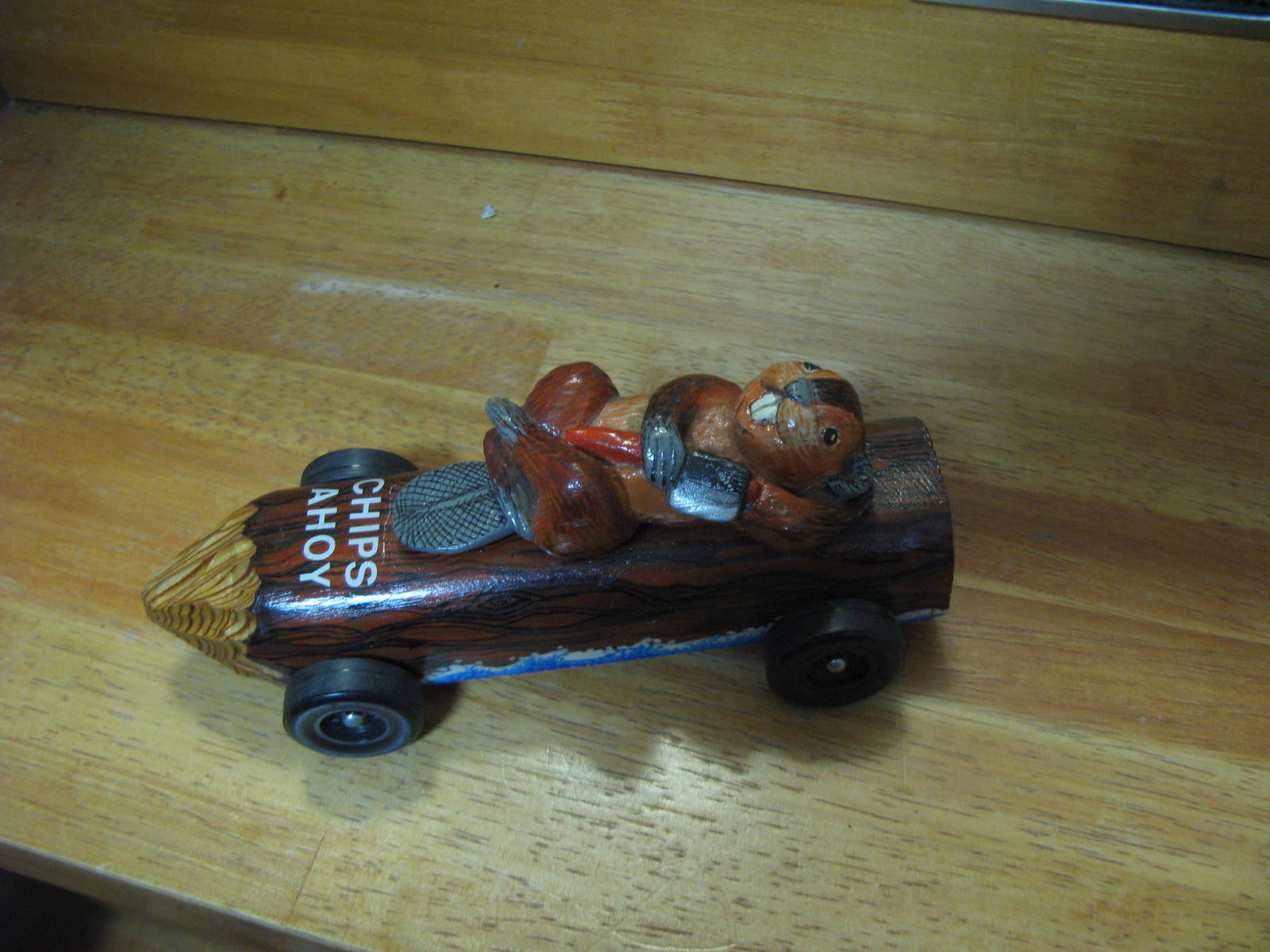
Here are the first five of the pinewood derby cars I made for our Pack's open competition.  This "Re-cycle" was made in 1983. Extra wood was added to raise the ends since the blocks in the kit had a dip in the center. A pull-tab was fastened to the front.


"Chips Ahoy" 1994 is carrying an axe because he was my Woodbadge patrol animal. The back end says, "Nice gnawing you".

The "Top Banana" was 1985. I filled the dip in the block with a piece of wood and added wood to the high end. As I recall, this was a pretty fast car.


1986 was an "E-racer". Nothing to add as I cut the block to the level of the notch.


1987 was the "Missing Link". I couldn't separate the links or the car would be too long but I freed the ball in the cage and the vibrations from the track caused it to turn as it ran.

All but the recycle have made trips to the National Jamboree where they were on display at the Boys' Life Whittling booth.

Thursday, April 26, 2012

The whittler joins Boy Scouts

My years as a Scout ended early, in Junior high, when the leader of our troop quit. I still remember the day when it happened. We had begged parents and teachers and members of our sponsoring organization. In those days, all we needed was one adult, but none would sign on. I still remember walking home that afternoon on the day that would have been our meeting, promising to myself that as long as there was a kid out there who wanted Scouting, I would do my best to see he or she got it.

It is not surprising, then, that during 16 years with Girl Scouts ... even without a troop I was asked to help with day camps and other activities through Jr. and Sr. HS and college ... and went through the program with all four of my own girls until they were no longer interested ... I found myself sitting with my eldest son in a Cub scout meeting and volunteered to be a leader.


One of our first challenges was the pinewood derby. The kits in those days were much like today's except that the block was cut with a lower part in the middle. I have little memory of how my son arrived at a plan for a shoe but it seems that somewhere along the way, another family member said, "hey, that looks like a shoe" and he grabbed the idea and ran.

My strongest memory of the race was not how his car did, it may have gotten a design prize because his next two cars went for design rather than car-looking models. We had registered his car and were sitting waiting for the race to begin and along side was another Cub who kept looking toward the door. Suddenly, he jumped up saying, "Dad! Dad! You got the car"? "Yeah, I got the car"!, was the reply. "Can I see it"? "Yeah, but don't touch"!

Oh foolish me, I had thought that the pinewood derby was a chance for a kid to take a block of wood and turn it into a car and have fun racing it.  At that point, there was little I could do about it. The Pack was run by guys with only a few female Den leaders. There was even a limit as to which Dens those few could lead ... not Webelos and not the Pack. But, I filed this bit of information away for a later date and when I finally had some say in the workings of the Pack, we began an "Open competition" The dads could make their own cars and race each other ... and ME. We have also gone to a "rough-cut day" where boys can get help cutting their cars into shapes of their own choosing. We also help them adjust the weight.

One boy brought in his "car" that was just the block of wood colored with marking pens. I told him it could use a bit more weight and helped him adjust it. That car won as fastest in the Pack, and you know what?, the mother was mad because she wanted to hold it to the father for not helping with the car! The boy was pleased because he had made the car all by himself.


In the days my sons joined Cub Scouts, there were just three years in the program. Third grade, wolf, forth grade, Bear and fifth grade,Webelo. These cars were made by my first son ... Super Sneaker, Power Pencil, and Speed-Ball.

My second son began with a "real car shape", the white one with flames painted on the sides. When it didn't get any prize, he opted out for the alligator in his Bear year and the "Pinewood Paddler" in his Webelo year. (the cub in the canoe was cut out of balsa and has broken many times). The Cobra was his Troop patrol and he entered the first open competition as a Den Chief. (In case you are wondering, he was born an artist and ended up attending Rhode Island School of Design).

By that time, though women were still not allowed to be Cubmasters, they could be assistant leaders and my husband took over the top slot until women were legal. Open competition became great fun for parents and leaders and siblings and father-made super cars are racing me and each other.

Wednesday, April 25, 2012

Instructor, Teacher, Mentor ... I whittle

When I reached Junior high, a wonderful thing happened. I had been attending "Member's Classes" at the Cleveland Museum of Art since early childhood and suddenly I was moved to a class with the world's greatest teacher. Not only that, when I moved to a new school, I discovered that wonderful teacher was also the art teacher for the school!  Six days a week! (and continued into high school) 

Up until then, I had had plenty of instructors but Fred Vollman was a renaissance man! He had a passion for everything and shared it with all his students. I learned much more than "art" in his classes.
Fred taught all kinds of art, watercolor, oil painting, calligraphy, costume design, poster making, pottery and ceramics, sculpture, copper enameling, silver jewelry making, paper mache, using a lathe,  and even wood carving, are some of what I remember.

His teaching style was each subject divided into three. First you learned the techniques and made a test piece. Then there were a few things you could choose to do using those techniques, and thirdly, if you finished early, you could use what you had learned in a project of your choice.

Somewhere around there are three horse carvings made in mahogany. (I was very much into horses in those days) The last one is bucking with its back feet in the air. Suddenly, I began to find more success in my life and much of that was due to the mentoring of Fred Vollman. By the time I graduated from high school, I was not a talented artist but I knew I wanted to become an art teacher and do for even one kid, what had been done for me.

I still like this teaching style and find the new woodcarving merit badge booklet has a section on making a test piece to demonstrate the variety of cuts needed for working with knives and wood. When I was at an OA conclave in Washington State, I met a woman woodcarving MB counsellor that went one step further to turn this test piece into a neckerchief slide. It is among the objects in the above picture.

I have never taught it that way but there is a certain positive aspect of being able to wear something you have made (like the dog pin in my first post) as a reminder of your success. I have sat Boards of Review for Scouts wearing a slide they have made for the Merit Badge. (I have also sat BORs for boys with the badge who couldn't even remember what they made to get the badge ... and they had to make two things!) I often wonder what kind of instructor they had at the time. The world could use a lot more Fred Vollmans.

Sunday, April 22, 2012

Whittling = KNIVES!

When it comes to whittling, you will need a knife.
After my first experience making something out of wood, I began to beg for a real knife, and when I turned ten, this is the knife I was given. It is a fine all-purpose knife but not such a great whittling knife. Unlike knives today, it holds a good sharp edge and is a handy tool.  That I have kept it over 65 years, shows the importance it had in my life.


One does not think of little girls and knives going together but my other passion was dolls. My dolls were my best friends but the ones they sold in the stores were made of china, (cold and breakable) or celluloid (not as strong as today's plastics) With a knife and some wood,you can have a doll the size and look you want.
 If you think it through, you can even get the parts to move ... an improvement over those rigid models found in the five and dime.
Unless you are left-handed, you may not have noticed that almost all knives are designed to be used by right-handers. Chopping vegetables with a kitchen knife is even a challenge  if you want nice even slices.

These two lock-blade knives are made by Gerber-Sakai. I have heard that Sakai was a sword-maker. I don't know the connection with Gerber but this is an excellent knife and I was able to buy a left-handed model. (the lower one with the dark blade) These knives hold a good keen edge.


I had never used anything but a commercial knife until I went to my first BSA Jamboree. There I first met "Whittling Jim" Hill at the Boy's Life whittling display.

I was not a stranger to Boy's Life or to Whittling Jim. When I was small, I joined Brownies and then Girl Scouts, but, my twin brother was a Cub and then Boy Scout and my Dad, a leader.They met in our basement and I sat on the top step and ate my heart out. Every month, into our post box came a copy of "American Girl" and "Boy's Life". My goal was to beat my brother to the post and check out the "Slide of the Month".
First, Ben Hunt, and then Jim Hill, were my heroes. I was always keen to try out the latest design. That collection has been lost over the years. Some I have done again but there are many more I remember having made when I see them in collections.

For two National Jamborees, I had other staff jobs and spent any free time I could grab in the whittler's tent. I was able to find a nice set of Japanese gouges for Jim and the above three knives were made by him, just for me, using German straight razors. The lower one is my favorite but the small horn handle fits so comfortably into my hand and all three keep such a nice sharp edge.

The past three Jamborees, I have been lucky enough to be admitted into this elite group of whittlers, as their token woman. What a wonderful place that is and what an inspiring group of people!

 These days, many knife companies are going to China for tools but to my thinking, Japan still makes some of the best cutting tools. Above is a set of hand-made tools, Each tool is made from one piece and the reed is woven to make a comfortable grip.

Even a commercial set of gouges for making block prints is quite good quality and not too expensive.

The last set of knives is what I use most. This craft knife is made by "Olfa". The blades can be reversed so that you have two blades in the same handle, but actually, they hold an edge so well, there is not much need to change them around. One set comes with two spare blades and the blades can be purchased separately. There are two styles of blades. The black handle has a pointed blade and the blue has a rounded tip. (I prefer the rounded tip for teaching beginners).

I use this craft knife to teach the "whittling chip" to Cub Scouts and the Woodcarving Merit Badge to Scouts. Besides having replaceable blades, this blade is friendly to either right or left handers. The round yellow knife is a small blade for details. It breaks  from time to time but comes with many spare blades. The silver craft knife is also made by Olfa but I would not recommend it for kids. These blades are easy to keep sharp. At the end of the day of use, I polish them up on a leather strop as I put them back in the box. They are always ready for use.

So ... what is your favorite knife?  What is your criteria for selecting a tool?

Wednesday, April 18, 2012

In the beginning...

I guess everything has to start somewhere. After putting whittling and Scout stuff on my quilting blog, I have decided to give it a place of its own.


I have always loved everything crafty. Growing up during the depression and war years, the culture was ... if you wanted something, you learned how to make it yourself.


Ordinarily, one does not think of little girls with knives but somehow it all started with a little dog pin. This is not whittling. It was drawn on a piece of plywood with colored pencils, cut out with a jig saw, and varnished. No one would ever be impressed... But ... as a very unsuccessful child, it was a reminder of one thing I had made that was successful, I could take it out and hold it in my hands, I didn't even have to wear it, and say to myself, "I made this".


A groove was cut on the back and a pin was glued there. Written below is the date. This pin was made in the summer of 1944, months before my 8th birthday.

I do not remember all the details but I do remember an elderly gentleman in the neighborhood cutting it out for me on his jig saw. To me, it was a reminder of my success and the beginning of something that has shaped my entire life.

Though I do not remember the name of that man, I hope I thanked him, because I will spend the rest of my life paying it forward. The lesson here is ... Success breeds success!

In one tiny corner of my childhood, I had a small reminder of success that I could hold in my hand, the first building block in a future of wood carving, not to sell or gain recognition, but to share with others ... and possibly pass on to the next generation.

As a Scouter for many years, I hope I can pass on a few ideas others might use and share the joys Scouting has given me.