Today I am preparing for teaching the whittling chit to Bears and Webelos in Two Tokyo Packs.
For preparation, all the blanks are cut out. We will use Olfa craft knives which work well both left and right handed/
The Bears will make bear neckerchief slides. The wood used tomorrow will be Hinoki. The samples are Katsura and Hinoki.. The nose piece on the blanks I made are Honoki ... Broad-leafed Magnolia.
The Webelos will make Scout signs. I used Honoki for these but I have some earlier cut pieces of Spruce.
I will take my camera but, knowing me, may be too busy to take pictures. I hope at least to get pictures of some of the finishes.
I have seen this taught with bars of soap and plastic knives. Not only was it a problem because the Cub Scouts did not have a vision of an object in the soap, but ended up with a mess, a waste of soap, and nothing memorable ...or even a good idea of how to handle a real knife.
On the other hand, over all the years I have taught this, each child has taken home an object to remind him of his success. Every bear turns out differently and unique. We use lots of sandpaper glued to Popsicle sticks
to smooth out the rough places.
Over the years we have had nicks ... but not many, and nothing a band aid couldn't take care of. My biggest challenge is not the sharp knives in the hands of boys, it is the "helicopter parents" hovering over the boys, ready to grab that knife and give it a few whacks too.
Friday, February 1, 2013
Tuesday, January 1, 2013
The Pack helps the Cub Scout grow.
I have been told that the BSA is getting rid of the Cub Scout Promise and Law of the Pack and going to use the same as the Boy Scouts. In my opinion, that is a big mistake. I have worked with this age children all my life and teaching them the meaning of "Mentally awake and morally straight" is too far over their heads, let alone those twelve points of the Scout Law! My Cub's books still have the old promise and law, so that is what we are still using.
Our pack gives segments for activities and many events include patches. I decided it might be useful for the Cubs to have a patch vest.
After reciting the law of the pack, I told the Cubs that the pack was going to help the Cub Scout grow, and that growing does not just mean getting bigger because they will do that anyway, with or without the Scouts.
Growing at that meeting meant getting new skills that they can use all their life.
During summer camp, a leader had a patch coming off his uniform and, knowing I was a quilter, asked if I had any thread to fix his patch. Well, I didn't have the right color but I told him I would sew it for him in a way the color of the thread would not matter.
While I was making those repairs, two of the youth staff came over and asked me to teach them to sew their own patches and badges in place. You can bet I was very happy to teach them.
Now it was my Cub's turn to learn to sew. I bought about six meters of red felt and made a pattern that only needed sewing across the two shoulder seams.
I was happy to see the moms encouraging and coaching but letting the boys do the work themselves. I did not hear one word of complaint from any kid.
Sitting at the back table, checking the boy's books, is my Right-hand-man, committee chair and Assistant Cub master all in one. He is supervising the next stage, the hammering of the grommets. Ah, the hammering part was the final reward for getting the sewing part done.
Next Pack meeting we will fix the ties in place while learning some basic knots. Maybe I will even get a picture of a Cub in a vest.
I am not so old that I can not look back to my own childhood and remember how I felt while using something I had made, thinking, "and I did this all by myself"! Good going boys!
Our pack gives segments for activities and many events include patches. I decided it might be useful for the Cubs to have a patch vest.
After reciting the law of the pack, I told the Cubs that the pack was going to help the Cub Scout grow, and that growing does not just mean getting bigger because they will do that anyway, with or without the Scouts.
Growing at that meeting meant getting new skills that they can use all their life.
During summer camp, a leader had a patch coming off his uniform and, knowing I was a quilter, asked if I had any thread to fix his patch. Well, I didn't have the right color but I told him I would sew it for him in a way the color of the thread would not matter.
While I was making those repairs, two of the youth staff came over and asked me to teach them to sew their own patches and badges in place. You can bet I was very happy to teach them.
Now it was my Cub's turn to learn to sew. I bought about six meters of red felt and made a pattern that only needed sewing across the two shoulder seams.
I was happy to see the moms encouraging and coaching but letting the boys do the work themselves. I did not hear one word of complaint from any kid.
Sitting at the back table, checking the boy's books, is my Right-hand-man, committee chair and Assistant Cub master all in one. He is supervising the next stage, the hammering of the grommets. Ah, the hammering part was the final reward for getting the sewing part done.
Next Pack meeting we will fix the ties in place while learning some basic knots. Maybe I will even get a picture of a Cub in a vest.
I am not so old that I can not look back to my own childhood and remember how I felt while using something I had made, thinking, "and I did this all by myself"! Good going boys!
Monday, September 3, 2012
Crafts in the woods
Last summer, I took part in a joint Japan-U.S. Scout camp at Yamanaka.
I was asked to teach a craft. The boys ranged from older scouts all the way to "Beaver cubs", the youngest Japanese Scouting program.
The Owl is the symbol of the Yamanaka camp, so I decided to have the Scouts make owl neckerchief slides using materials gathered from the surrounding woods.
I brought craft knives, hand saws, wood glue, sandpaper, and quick-dry acrylic varnish. The day before, I picked up some pieces of wood from the area to give the boys an idea of what might be used. I also found some suitable sized pieces of bamboo to use for the slide back.
It was fun to watch the youth in action and to see the creative ideas they came up with.
This Scout took a second slice of wood, cut it in half, and added wings to his owl.
This Scout used a marking pen to add details.
With slight variations, there was quite a number of slides that came out of a days work. Below is the work of one group.
For the most part, all the kids (even to the youngest) were able to do all the work needed to complete their own slide.
Notice the adult is not sawing but helping to hold the bamboo.
At the end of the afternoon, when everyone had been through the activities, some of the groups and a few of the adults came back to more.
.
Bears, and Beavers?
I don't think Yamanaka will change its mascot.
This coming weekend I will camp again at Yamanaka with my Cub pack.
I think this will be a good activity for those youth as well. One does not need to spend a lot of money on craft supplies when you can use what nature provides.
Monday, June 11, 2012
Summer camp or Merit Badge Mill?
By this time next week, I will be out in the woods with the guys. No internet. No TV. No news. Night will be dark with no electricity and morning will arrive early with the calling of birds. I will miss my comfortable futon and worry about my house plants but... in the end... it will all be worth while.
As with every year, my job will be teaching woodcarving and leatherworking merit badges and the nature requirements for the first class trail. The Scouts who take my classes will be doing their own work. What they take home at the end will be evidence of the time and effort they have put in.
Not long ago, I sat in a Board of Review for a Scout going for the rank of Eagle. I happened to notice on his form that he had earned the woodcarving merit badge and asked him what he had made. His reply was that he didn't remember. Huh? That badge requires that you carve one object in the round and one in low relief. Looking again at the dates listed, I found he had taken this class the summer before at a Scout camp. Then, checking his list of Merit badges, I saw that the same date, he had "earned" a total of eight badges and asking further, discovered he knew little of any of those subjects. I can not blame the Scout but I DO blame those who were "teaching" the courses.
Last summer I shared my craft area with a Scouter who was teaching insect study. I am always interested in nature and have taught that badge myself to a boy who now has a PHD in entomology. I looked up the requirements and see they have changed greatly from those days. I recall that Scout had to collect and mount a large number of bugs, I recall the stories of his quests and the process by which he learned to preserve his mounts. I remember his passion for bugs and seeing him stop an activity he was doing to help a fellow younger Scout learn about a critter he had found.
I was asked by the counsellor for ideas where she could get an insect for the Scouts to raise from larvae to adult. Well, I raise silk worms but in less than a week, that would not be possible in that length of time nor would a swallowtail butterfly work as it pupates over the winter. I went down to the drainage ditch and fished out some mosquito wigglers and asked if they would do and told her where the boys could go to collect some. However, in the end, the boys did nothing but look at those I had gathered and wait for them to become adults. Granted, there is not a lot of care needed to "raise" a mosquito but what might have been a good learning opportunity was passed over and signed off.
More and more I see leaders who do all the research and deliver it to a bored class in lecture form and sign off the blue cards that the scout has completed the requirements. Then I think of my own sons. The boy who took his environmental MB pamphlet to his HS Science teacher saying some of those requirements might be more fun to do than what the teacher was planning. That boy is now an environmental scientist. Or the other son who worked out a plan, listed his goals and priorities, and now is running his own business.
I owe a great debt of gratitude for what Scouting did for my sons and I hope my classes will do the same for the youth I work with. They will at least learn to use a knife safely without depending on Kevlar gloves. They will have no need for a kit but know how to plan a project and pull it off. They will go out into nature and use their own observation skills to identify plants and trees and birds and animals. They will tell me, not the other way around, and those skills will go home with them and serve them all their lives. I'll bet, too, when they sit for their next BOR, they will remember what it was they made for the badge.
As with every year, my job will be teaching woodcarving and leatherworking merit badges and the nature requirements for the first class trail. The Scouts who take my classes will be doing their own work. What they take home at the end will be evidence of the time and effort they have put in.
Not long ago, I sat in a Board of Review for a Scout going for the rank of Eagle. I happened to notice on his form that he had earned the woodcarving merit badge and asked him what he had made. His reply was that he didn't remember. Huh? That badge requires that you carve one object in the round and one in low relief. Looking again at the dates listed, I found he had taken this class the summer before at a Scout camp. Then, checking his list of Merit badges, I saw that the same date, he had "earned" a total of eight badges and asking further, discovered he knew little of any of those subjects. I can not blame the Scout but I DO blame those who were "teaching" the courses.
Last summer I shared my craft area with a Scouter who was teaching insect study. I am always interested in nature and have taught that badge myself to a boy who now has a PHD in entomology. I looked up the requirements and see they have changed greatly from those days. I recall that Scout had to collect and mount a large number of bugs, I recall the stories of his quests and the process by which he learned to preserve his mounts. I remember his passion for bugs and seeing him stop an activity he was doing to help a fellow younger Scout learn about a critter he had found.
I was asked by the counsellor for ideas where she could get an insect for the Scouts to raise from larvae to adult. Well, I raise silk worms but in less than a week, that would not be possible in that length of time nor would a swallowtail butterfly work as it pupates over the winter. I went down to the drainage ditch and fished out some mosquito wigglers and asked if they would do and told her where the boys could go to collect some. However, in the end, the boys did nothing but look at those I had gathered and wait for them to become adults. Granted, there is not a lot of care needed to "raise" a mosquito but what might have been a good learning opportunity was passed over and signed off.
More and more I see leaders who do all the research and deliver it to a bored class in lecture form and sign off the blue cards that the scout has completed the requirements. Then I think of my own sons. The boy who took his environmental MB pamphlet to his HS Science teacher saying some of those requirements might be more fun to do than what the teacher was planning. That boy is now an environmental scientist. Or the other son who worked out a plan, listed his goals and priorities, and now is running his own business.
I owe a great debt of gratitude for what Scouting did for my sons and I hope my classes will do the same for the youth I work with. They will at least learn to use a knife safely without depending on Kevlar gloves. They will have no need for a kit but know how to plan a project and pull it off. They will go out into nature and use their own observation skills to identify plants and trees and birds and animals. They will tell me, not the other way around, and those skills will go home with them and serve them all their lives. I'll bet, too, when they sit for their next BOR, they will remember what it was they made for the badge.
Sunday, May 27, 2012
Cub camp (or how to prevent a walking stick from becoming a weapon of mass destruction)
For the last thirty years or so, it has been assumed that I will take over the craft segment of Cub camp. Usually I am asked to come up with a suggested craft and let the organizers know what supplies I might need. So far, this has worked pretty well. A few times we had to tweak the plan when the parts did not show up but basically, we had a good craft that would be successful for boys of all ages and keep them busy for the allotted time.
This year, however, I was not asked but told that they had ordered 200 walking sticks and had colored markers for the boys to use to decorate them. Yeah right! six classes of 30 boys (plus siblings) are going to sit there for an hour and ten minutes each, decorating a walking stick??? And I assume I am also responsible for the ensuing chaos.
My friend and fellow leader (also a mother of two boys) was as shocked as I. We went through our stash of crafty stuff looking for something that would make the sticks a bit more user-friendly.
Between us we came up with some turkey feathers, some fluffies and pom-poms, some felt, thong material, rope and pony beads. We decided the sticks would get a rope grip with a ring, to which we would tie a memory feather.
I made up a story line to go with the activity:
Once there was a boy named Lone Wolf. He lived with his father and their tribe on an Indian reservation. Now, during the winter, the father had gone out of the reservation to see what was happening in the outside world. Spring had come and then summer but father had not returned. School was soon to begin and Lone Wolf decided he would go on a vision quest. All the adults told him he was much too young but he was determined to try, so one day he rolled up his blanket and water skin and tied it with rope and set out to the nearby mountains.
After a while, he got tired and saw a nice shady tree where he could sit for a moment to rest. As he sat, he listened to the wind rustling the branches so it seemed that the tree was speaking to him. "Lone Wolf, what are you doing here"? Well, when Lone Wolf explained his mission, the tree thought he was way too young but if he insisted on going, the tree had lots of high branches holding its leaves to the sun but there was a lower branch he could have to use as a walking stick to lean on when the going got tough. And, as he was getting ready to leave, the tree suggested he might want to take some of the twigs and branches on the ground for a fire. Lone Wolf opened his blanket and placed the bundle of wood he gathered on it and rolled it back up, put it over his shoulder, thanked the tree, and set off with his new stick.
As Lone Wolf walked farther, he became thirsty. He heard a soft tinkling in the distance and followed the sound to a small brook. There he filled his water skin. He had a long drink and took some water for the trip and to put out the fire. Just as he was about to leave, he saw something bright like a bubble in the water. When he reached for it, it became a small bell. This he put in his medicine pouch to remind him of the refreshing water each time he heard the sound.
Now the path became steeper and Lone Wolf was above the tree line. All around were just low bushes and he heard the song of a little bird as it came hopping along from twig to twig. The bird was surprised to see him there and asked what he was doing so far from his village. When he told the bird he was on a vision quest, the bird was quite surprised, thinking him much too young to be hurrying through life. The bird told him, "though I can fly high and fast, I can not find food that way. It is better to take the journey one step at a time, hopping from branch to branch, eating, resting, seeing the flowers, and being so happy as to sing". The bird reached back and pulled out a feather which he gave to Lone Wolf to remind him to take it one step at a time, not to rush through life, and Lone Wolf put that feather with into his medicine pouch with the bell, thanked the little bird and went on up the mountain.
It was late in the day and beginning to get dark. The bushes and trees were way below and the trail led between two big rocks. Just as Lone Wolf was going through, he was hit in the face by a huge spider web. "Wait, Wait"! called the spider "Where are you going"? Well, by now, you know what the conversation was like. The spider told Lone Wolf to stay right there and she would come down and get him un-tangled from the web. Of course there was discussion about the extreme strength of spider silk and the spider gave him a length to take with him, in case he might need it and to remind him about how nature is a cord tying all mankind and itself together.
Just as he was about to go his way, Lone Wolf looked up to thank the spider and saw something glittering in the web. He asked the spider what it was and the spider explained that the dew gathers in the evening on the web and that was the reflection of the sun and moon and the stars and how important they were for finding one's direction. The spider climbed up and brought the sparkling bits down to Lone Wolf and when they were dropped in his hand, they turned to beads. Lone Wolf could identify one that was yellow like the sun and one that was white like the moon and others that looked like stars and flowers and nature around him. All these he put in his pouch, thanked the spider and went on up to the top of the mountain.
At a place near the top, he opened his blanket and set up the wood, took out his flint and struck it with his knife and soon had a cheery fire going. He sat with his back against a boulder and took out his medicine pouch and placed the things he had been given onto his blanket.
Suddenly he heard a voice from the top of the rock behind him. There were the usual questions about what he was doing there and how he was much too young etc. But the eagle, who was speaking now, said,"I have a better quest for you. One that is more suitable to someone your age" .And the Eagle told him all about Scouting and the "Trail to Eagle" Then the eagle gave Lone Wolf a "Working feather" If he looked closely he could see the feather was a bit worn. The eagle had used that feather all through the year while raising young, finding food for them and teaching them to fly and hunt for themselves. Now the eagle would be getting new feathers and Lone Wolf should keep that one to remind him of the new path of the Scout.
Lone Wolf took the feather and made the end into a loop (demonstration) attached the small feather, a bit of blanket (felt) and the beads and hung it from his walking stick so that he would always remember his new vision in life.
In the morning, Lone Wolf put out his fire and went back down the mountain. As he was almost to his village when he saw someone coming in the distance. Well, it was his father. Of course they were glad to see each other and Lone Wolf showed his stick and told his father all about the meaning of the feather and beads and that he had a goal of becoming a Scout and maybe some day, an Eagle Scout. The Father, too, had learned all about Scouting on the outside world and was ready to help Lone Wolf along the trail, changing his name to "Brave Wolf" for what he had accomplished.
This year, however, I was not asked but told that they had ordered 200 walking sticks and had colored markers for the boys to use to decorate them. Yeah right! six classes of 30 boys (plus siblings) are going to sit there for an hour and ten minutes each, decorating a walking stick??? And I assume I am also responsible for the ensuing chaos.
My friend and fellow leader (also a mother of two boys) was as shocked as I. We went through our stash of crafty stuff looking for something that would make the sticks a bit more user-friendly.
Between us we came up with some turkey feathers, some fluffies and pom-poms, some felt, thong material, rope and pony beads. We decided the sticks would get a rope grip with a ring, to which we would tie a memory feather.
I made up a story line to go with the activity:
Once there was a boy named Lone Wolf. He lived with his father and their tribe on an Indian reservation. Now, during the winter, the father had gone out of the reservation to see what was happening in the outside world. Spring had come and then summer but father had not returned. School was soon to begin and Lone Wolf decided he would go on a vision quest. All the adults told him he was much too young but he was determined to try, so one day he rolled up his blanket and water skin and tied it with rope and set out to the nearby mountains.
After a while, he got tired and saw a nice shady tree where he could sit for a moment to rest. As he sat, he listened to the wind rustling the branches so it seemed that the tree was speaking to him. "Lone Wolf, what are you doing here"? Well, when Lone Wolf explained his mission, the tree thought he was way too young but if he insisted on going, the tree had lots of high branches holding its leaves to the sun but there was a lower branch he could have to use as a walking stick to lean on when the going got tough. And, as he was getting ready to leave, the tree suggested he might want to take some of the twigs and branches on the ground for a fire. Lone Wolf opened his blanket and placed the bundle of wood he gathered on it and rolled it back up, put it over his shoulder, thanked the tree, and set off with his new stick.
As Lone Wolf walked farther, he became thirsty. He heard a soft tinkling in the distance and followed the sound to a small brook. There he filled his water skin. He had a long drink and took some water for the trip and to put out the fire. Just as he was about to leave, he saw something bright like a bubble in the water. When he reached for it, it became a small bell. This he put in his medicine pouch to remind him of the refreshing water each time he heard the sound.
Now the path became steeper and Lone Wolf was above the tree line. All around were just low bushes and he heard the song of a little bird as it came hopping along from twig to twig. The bird was surprised to see him there and asked what he was doing so far from his village. When he told the bird he was on a vision quest, the bird was quite surprised, thinking him much too young to be hurrying through life. The bird told him, "though I can fly high and fast, I can not find food that way. It is better to take the journey one step at a time, hopping from branch to branch, eating, resting, seeing the flowers, and being so happy as to sing". The bird reached back and pulled out a feather which he gave to Lone Wolf to remind him to take it one step at a time, not to rush through life, and Lone Wolf put that feather with into his medicine pouch with the bell, thanked the little bird and went on up the mountain.
It was late in the day and beginning to get dark. The bushes and trees were way below and the trail led between two big rocks. Just as Lone Wolf was going through, he was hit in the face by a huge spider web. "Wait, Wait"! called the spider "Where are you going"? Well, by now, you know what the conversation was like. The spider told Lone Wolf to stay right there and she would come down and get him un-tangled from the web. Of course there was discussion about the extreme strength of spider silk and the spider gave him a length to take with him, in case he might need it and to remind him about how nature is a cord tying all mankind and itself together.
Just as he was about to go his way, Lone Wolf looked up to thank the spider and saw something glittering in the web. He asked the spider what it was and the spider explained that the dew gathers in the evening on the web and that was the reflection of the sun and moon and the stars and how important they were for finding one's direction. The spider climbed up and brought the sparkling bits down to Lone Wolf and when they were dropped in his hand, they turned to beads. Lone Wolf could identify one that was yellow like the sun and one that was white like the moon and others that looked like stars and flowers and nature around him. All these he put in his pouch, thanked the spider and went on up to the top of the mountain.
At a place near the top, he opened his blanket and set up the wood, took out his flint and struck it with his knife and soon had a cheery fire going. He sat with his back against a boulder and took out his medicine pouch and placed the things he had been given onto his blanket.
Suddenly he heard a voice from the top of the rock behind him. There were the usual questions about what he was doing there and how he was much too young etc. But the eagle, who was speaking now, said,"I have a better quest for you. One that is more suitable to someone your age" .And the Eagle told him all about Scouting and the "Trail to Eagle" Then the eagle gave Lone Wolf a "Working feather" If he looked closely he could see the feather was a bit worn. The eagle had used that feather all through the year while raising young, finding food for them and teaching them to fly and hunt for themselves. Now the eagle would be getting new feathers and Lone Wolf should keep that one to remind him of the new path of the Scout.
Lone Wolf took the feather and made the end into a loop (demonstration) attached the small feather, a bit of blanket (felt) and the beads and hung it from his walking stick so that he would always remember his new vision in life.
In the morning, Lone Wolf put out his fire and went back down the mountain. As he was almost to his village when he saw someone coming in the distance. Well, it was his father. Of course they were glad to see each other and Lone Wolf showed his stick and told his father all about the meaning of the feather and beads and that he had a goal of becoming a Scout and maybe some day, an Eagle Scout. The Father, too, had learned all about Scouting on the outside world and was ready to help Lone Wolf along the trail, changing his name to "Brave Wolf" for what he had accomplished.
The group was divided in half and one section began to decorate their stick and work on the grip. The other half began to work on their feather. They put a bit of glue on the top of the feather and added the fluffie, then wrapped it with a piece of felt that had some double-stick tape to help hold it in place, and tied it top and bottom with string wrapped tightly and tied in a square knot. If the feather was a bit messed up at the tip (some were rather old) the Cub could add a tassel and pompom as wished.
A thong went through the loop in the quill and on that he could put as many beads as he wished. The only rule was, each bead had to represent something he wished to remember. It could be a person or an experience or something at camp or something about nature, it was up to the kid. (I saw some put red ,white, and blue beads as it was memorial day weekend. There were some school colors too. I showed the Scouts the beads on my medicine pouch and told them about what some represented to me. I told them when I was small, we tied a string on our finger to remember things but this was much better, you could remember lots of things and I added a small blue flower-shaped pony bead to my pouch thong to remember the camp and all those Cubs, just bursting into bloom with new skills, like a flower beginning to bloom.
Did we avoid weaponry? I heard there was a bit but, for the most part, they remained hiking sticks. I did the prepping by cutting the quills and tucking the loop in the bottom with a touch of glue. Also the felt had to be cut and backed with double-stick tape. Several men came to help with the grip tying and my friend manned the station dispensing fluffies, beads, and thongs. A "parking lot" was set up for the sticks so the Cubs would have their hands free for feather work. There were colored pens and sandpaper and stuff for decorating the sticks and we had a hand-out with suggestions of how a stick could be used.
Luckily the weekend which had begun with rain, turned into a fine night and day. Though I would have liked a bit more time... like a week or so... to do the prep work, I would say the crafts turned out successfully. I wonder where those memory feathers are now. I wonder if those cubs will recall the camp in another week, month or year when they look at their hiking stick. I know I will not even need to look at that blue bead to remember this one!
Monday, May 7, 2012
The Cubmaster's Challenge ... (bribe)
Years ago, when the Webelos program was extended to two years, I found that, by the first year, the youth had managed to earn the Webelos badge and there was not much of a challenge to go on for the "Arrow of Light".
To stretch the second year youth a bit farther, I offered a challenge... To complete all the activity pins in the book and earn the "Panda" and religious knot by the time one bridged into Boy Scouts. The prize was a hand-carved neckerchief slide.
At first, the slide I carved was a ball and chain. It was carved of beechwood which is quite hard. Every year I had just a few boys complete the challenge so carving that slide was no problem. I wrote the twelve points of the Scout Law on the rotating ball.
Then, one year, a whole den of Webelos took up the challenge and completed everything. I seem to recall there were seven or eight boys in that den. From then on, I switched to a Scout sign slide.
This year one boy has met the challenge. He is no longer in my Pack but remembered the promise and met the challenge. The one I am carving here is from katsura wood. It will be the color of the lower slide when varnished. The one above is of hinoki (false cypress) . These are two of my favorite woods.
As a side note, more often than not, the boy who works for this award is likely to meet my second challenge. If he makes "Eagle" I will carve him an eagle slide. It is very rewarding to see that youth trade one slide for another. Often those youth have moved away from Japan and I send about five or six slides overseas every year with my congratulations.
To stretch the second year youth a bit farther, I offered a challenge... To complete all the activity pins in the book and earn the "Panda" and religious knot by the time one bridged into Boy Scouts. The prize was a hand-carved neckerchief slide.
At first, the slide I carved was a ball and chain. It was carved of beechwood which is quite hard. Every year I had just a few boys complete the challenge so carving that slide was no problem. I wrote the twelve points of the Scout Law on the rotating ball.
Then, one year, a whole den of Webelos took up the challenge and completed everything. I seem to recall there were seven or eight boys in that den. From then on, I switched to a Scout sign slide.
This year one boy has met the challenge. He is no longer in my Pack but remembered the promise and met the challenge. The one I am carving here is from katsura wood. It will be the color of the lower slide when varnished. The one above is of hinoki (false cypress) . These are two of my favorite woods.
As a side note, more often than not, the boy who works for this award is likely to meet my second challenge. If he makes "Eagle" I will carve him an eagle slide. It is very rewarding to see that youth trade one slide for another. Often those youth have moved away from Japan and I send about five or six slides overseas every year with my congratulations.
Monday, April 30, 2012
Got knife, will travel ... but not to Japan!
Sometime last year, Japan issued new rules for carrying knives. Even before the rules were supposed to go into effect, I began to hear horror stories. The first was from a fellow Scouter, he was sitting in his car, waiting for his wife to return from a quick shopping trip in the near-by store. The police came by and asked what he had in his car (which is a storehouse of his scouting gear) . Then, they went through and removed his camp knives ... including a fishing knife he had thought lost, which they found under a seat. It seems he was also dragged to the police station and charged with carrying weapons( ( or something like that).
About a week after that event, with the new law due to kick in still a week away, an elderly foreigner stopped by a police box, in a part of town where foreigners often go for entertainment, to ask directions. In the course of conversation, the police asked him if he had a knife. The guy pulled out a pocket knife he had had all his life, much like mine, and not only was it taken from him, he was hauled in and booked!
Therefore, looking ahead, I paid a visit last week to my local "koban"(police box) to check the process I need to do to teach knife skills to Cubs and Boy Scouts. My local police are not much into knife confiscation but you never know... The officer on duty called the headquarters and asked. He learned you can carry a knife (maybe) but the blade can't be over 6cm. As you can see, my old pocket knife is in danger. I suspected as much because I think that old tourist was carrying a typical pocket knife. Whether it is the sharpened edge that is measured or the entire blade is also somewhat foggy.
I took the "Totin' Chip" and "Whittling Chip" cards and showed them to the officer and asked how he proposed I teach these things without actually having a knife ... unless I do it in my own little room. How can I get my tools to camp without having them taken away? What keeps the police from standing outside the knife store and grabbing your purchase as you come out the door?
In the end, I was sent to the web site where you can down-load several pages of forms (in Japanese, of course) . These I need to fill out and take to headquarters where I can get a permission slip to tote my knives. It is not clear if I need a new slip for each time I go out with a knife or if I need to know the exact date of the event where I will use the knife (time and location and number of participants)
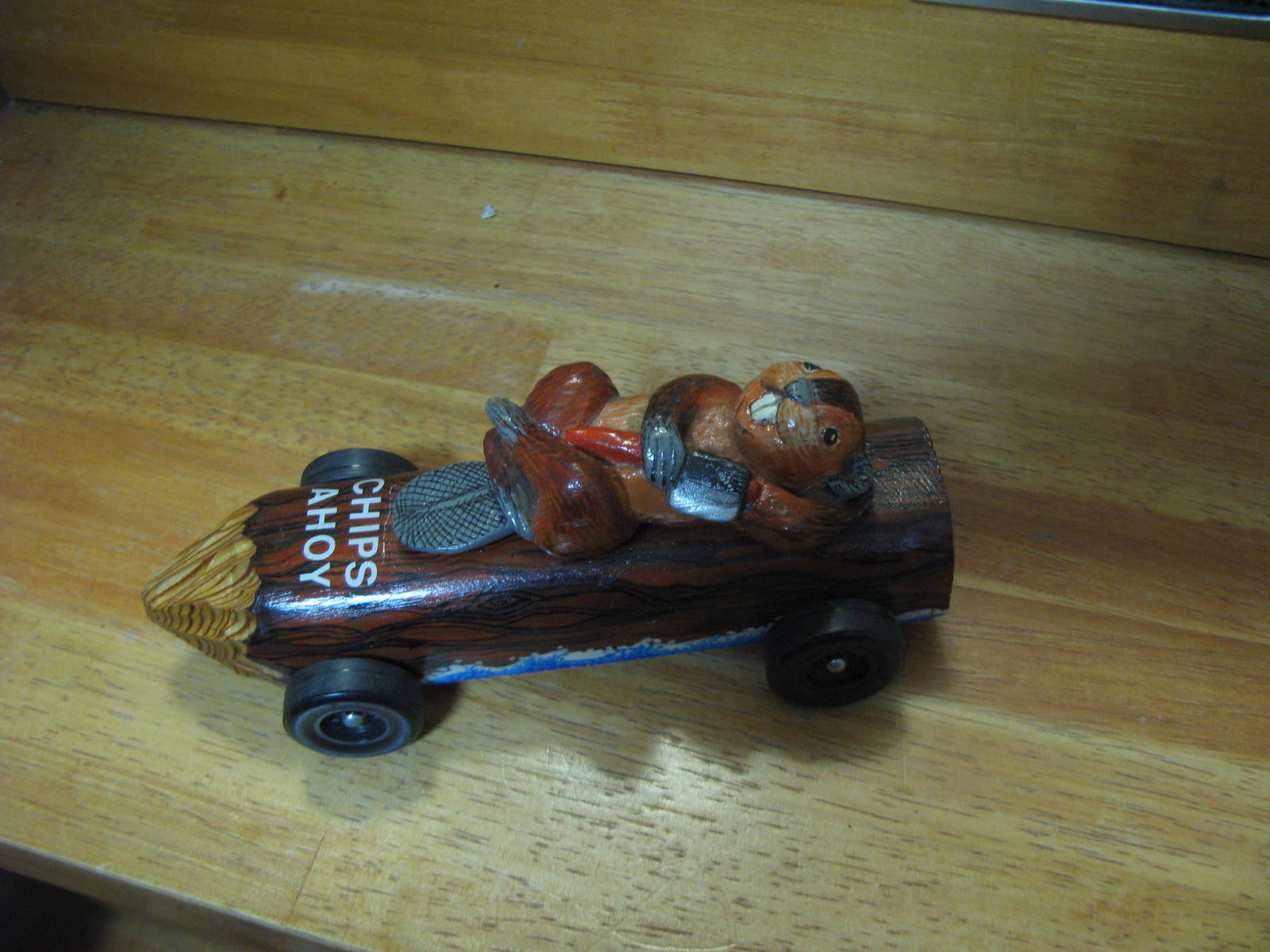
"Chips Ahoy" 1994 is carrying an axe because he was my Woodbadge patrol animal. The back end says, "Nice gnawing you".
The "Top Banana" was 1985. I filled the dip in the block with a piece of wood and added wood to the high end. As I recall, this was a pretty fast car.
1986 was an "E-racer". Nothing to add as I cut the block to the level of the notch.
About a week after that event, with the new law due to kick in still a week away, an elderly foreigner stopped by a police box, in a part of town where foreigners often go for entertainment, to ask directions. In the course of conversation, the police asked him if he had a knife. The guy pulled out a pocket knife he had had all his life, much like mine, and not only was it taken from him, he was hauled in and booked!
Therefore, looking ahead, I paid a visit last week to my local "koban"(police box) to check the process I need to do to teach knife skills to Cubs and Boy Scouts. My local police are not much into knife confiscation but you never know... The officer on duty called the headquarters and asked. He learned you can carry a knife (maybe) but the blade can't be over 6cm. As you can see, my old pocket knife is in danger. I suspected as much because I think that old tourist was carrying a typical pocket knife. Whether it is the sharpened edge that is measured or the entire blade is also somewhat foggy.
I took the "Totin' Chip" and "Whittling Chip" cards and showed them to the officer and asked how he proposed I teach these things without actually having a knife ... unless I do it in my own little room. How can I get my tools to camp without having them taken away? What keeps the police from standing outside the knife store and grabbing your purchase as you come out the door?
In the end, I was sent to the web site where you can down-load several pages of forms (in Japanese, of course) . These I need to fill out and take to headquarters where I can get a permission slip to tote my knives. It is not clear if I need a new slip for each time I go out with a knife or if I need to know the exact date of the event where I will use the knife (time and location and number of participants)
Only old lady foreigners would ask such questions. The general public would just give up and accept the law. The saga to be continued.
Here are the first five of the pinewood derby cars I made for our Pack's open competition. This "Re-cycle" was made in 1983. Extra wood was added to raise the ends since the blocks in the kit had a dip in the center. A pull-tab was fastened to the front.
"Chips Ahoy" 1994 is carrying an axe because he was my Woodbadge patrol animal. The back end says, "Nice gnawing you".
The "Top Banana" was 1985. I filled the dip in the block with a piece of wood and added wood to the high end. As I recall, this was a pretty fast car.
1986 was an "E-racer". Nothing to add as I cut the block to the level of the notch.
1987 was the "Missing Link". I couldn't separate the links or the car would be too long but I freed the ball in the cage and the vibrations from the track caused it to turn as it ran.
All but the recycle have made trips to the National Jamboree where they were on display at the Boys' Life Whittling booth.
Subscribe to:
Posts (Atom)